
The Dinosaur Goes Digital
A 25-Year Trader's Descent into the AI Rabbit Hole

My competition is a multibillion dollar server farm in New Jersey — or more precisely, the PhDs, math geniuses, and rocket scientists printing cash for the billion-dollar HFT fund that owns it. They compute complex models, develop advanced strategies, dream up novel products to throw at retail traders, and ultimately move billions of dollars from these “less sophisticated” traders into their already loaded coffers.
Meanwhile, I sit in my spare bedroom in Spain — with a lovely view of the Mediterranean and a Moorish castle — hunting and pecking on my keyboard. Scalping premarket moves before the US meme trading hordes hit snooze for the second time. Waiting for the moment one of them naively or accidentally hits my offer sitting across a gaping spread. And then there are the nights when I’m supposed to be sleeping, but instead I’m trading on Polymarket — getting what I think is a sweet price on whether a politician might utter “tampon” during a live presidential debate — one of my tens of thousands of losing trades.
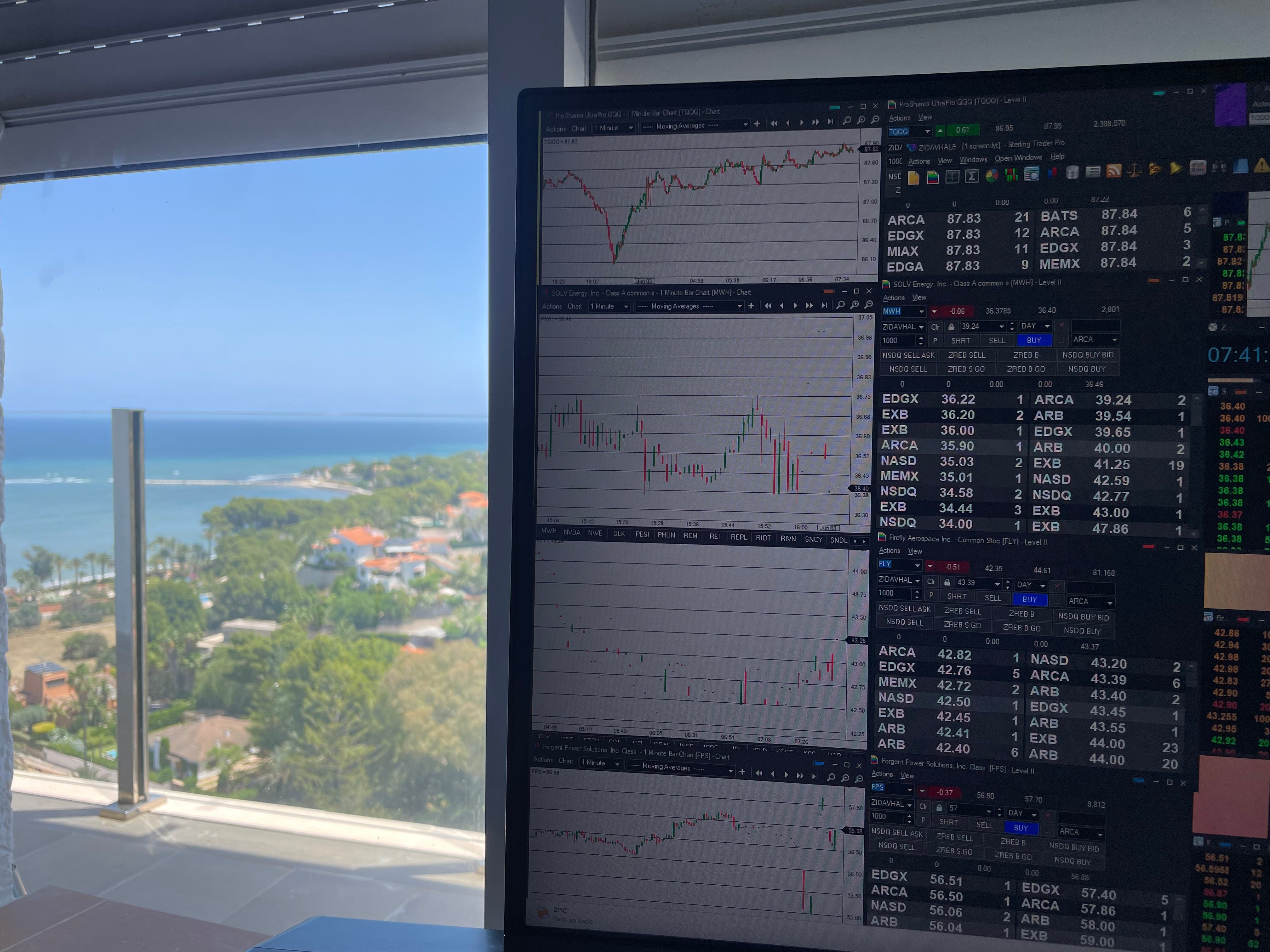
From the fluorescent-lit prop floors of suburban Texas, to the granite and glass of the City of London, to a rickety office above a Polish market square where the heating worked maybe half the time, to the sun-drenched Costa Blanca. 25 years of battle. One very battered keyboard.
The castle and the tiny fish swimming in the sea I can see from my window are perfect analogies for my trading. The castle — standing the test of time, yet ancient and almost entirely lost in the past. And those little fish, darting between the bigger, well-fed predators, looking for any scrap they can get.
While the rest of the trading world has been quietly building algorithms, deploying machine learning models, and automating everything down to the last decimal point, this minnow scavenges. Doing it the old way. By hand.
The Waters Got Dangerous
It wasn’t always like this.
I remember the good old days. Competing against naive retail traders and clunky, slow bots that telegraphed their moves. A market structure full of glitches, mispricings, and gaps that a halfway-attentive trader could drive a truck through. The sea was full of easy prey and the predators were slow. I swam confidently and usually with a full belly.
Over the years, the bots got better. The glitches got patched. The easy edges disappeared — and when new ones appeared, they vanished faster than ever. Where I used to compete against blunt instruments, I was suddenly up against precision machines. The slow trawlers turned into state-of-the-art factory ships, hoovering up everything in their path. The waters got dangerous.
Without the tech skills to fight back, I fell back on what I had: experience, instinct, and feel. I learned to find the edges too small or too niche for the big players to bother with. Tech was more foe than friend. I kept my distance and worked around it.
Then AI arrived. And my instinct was pessimism.
More competition. More efficiency. Markets hoovered cleaner by smarter, faster, cheaper bots.
My tape reading skills — the thing I’ve quietly relied on as my last real edge — starting to feel like those ancient tools displayed behind glass in that castle. Relics of another era. Though a good old hammer still has its uses — just as being able to spot a big bid in the order book still comes in handy. I’m still pretty quick to smash that offer.
The barriers to entry collapsing — no more pattern day trading rules, funded challenges dressed up as lotteries, a generation of retail investors flush with bull market gains, 24-hour crypto, 0DTEs, and now AI supposedly doing all the heavy lifting.
And my ears being chewed off by friends who’ve never traded a day in their lives, suddenly wanting to talk about nothing but markets and their new trading bots.
So somewhere between curiosity and desperation — and perhaps a growing desire to escape the grind of manual trading — I prodded Claude to help.
Down the Rabbit Hole
My first task was to see if Claude could confirm my strategies still had edge, and that it was merely the sloppy execution of a slow, middle-aged trader with dull reflexes and a fried brain holding them back. Execution is always an easier fix than a broken strategy. Just a quick dip.
Two weeks later I surfaced, blinking, slightly manic, surrounded by backtests, performance dashboards, equity curves, and the dawning realization that I had been leaving money on the table for years — money I could now see, quantified, in a graph, in pretty colors.
Claude built what took me months of manual work in minutes. Ran my strategies across years of data, filtered for the conditions I care about, stress-tested the parameters, and handed me back numbers I could actually use. Shiny dashboards. Code ready to plug into APIs. The next step: automation.
And yes — the edge was there. Of course it was.
You don’t survive twenty-five years in this game without one. And forget feel, forget instinct, forget all that other nonsense — the number one thing experience actually gives you is the ability to recognize an edge. To know what one looks like. To know where to look.
What I discovered — painfully, but honestly not surprisingly — is that execution can be done better with a simple Claude script than with twenty-five years of keyboard experience.
The Reckoning
I was not prepared for what Claude could do.
I’ve traded through the dot-com bubble, 2008, the rise of algo trading, the crypto explosion, the meme stock era. I thought I’d seen everything.
I hadn’t.
Things that used to require months of work, specialized skills, cost tens of thousands of dollars, or simply weren’t possible for someone like me — done. In minutes. Strategy analysis, backtesting, dashboards, risk metrics, code that would take a pro weeks to write. All of it, on demand, getting better every week.
If you’re not using these tools, you are falling behind. Not eventually. Now. The gap between those who adapt and those who don’t is opening — and once it opens, it doesn’t close.
I spent twenty-five years telling myself I didn’t need this stuff. I was wrong.
The Punchline
The HFT firms rolling out all these addictive products — the 5-minute prediction markets, the leveraged crypto perps, the funded challenges — are not worried about you asking Claude to build you a money-making bot. They’re delighted. Every new product is a fresh trap engineered to extract money from participants convinced the game is easy. The casino just got a lot more customers who think they’ve cracked the system.
But every trap needs bait. And bait creates opportunity — if you know what you’re looking at. These products are volatile, inefficient, and in their early days full of structural quirks the firms haven’t bothered to close. They’re too busy counting the fees. For a trader with the right skills and a genuine feel for what edge looks like, a new product launch isn’t a threat. It’s a feeding frenzy.
Good. More minnows. More new markets. More crumbs.
Those firms aren’t interested in the crumbs. They never were. Ten million in a trade is noise to them. It’s a career to us. The scraps they leave behind — structural inefficiencies, niche mispricings, corners of the market too small to move their needle — are still there. And AI doesn’t close those doors. For traders who know how to find the scraps, it opens them wider.
What changed my thinking wasn’t the dashboards. It was realizing that the one thing Claude is genuinely bad at — the thing no AI has figured out — is finding the edge in the first place. It can build the strategy, backtest it, automate it. It cannot hand you the idea.
That’s still the job. That’s still the hard part. That’s still entirely human. And it was always about finding the edge — AI just makes that more exposed. Execution was always the easier problem. Now that Claude handles it, the only thing standing between a trader and real profitability is the one thing it can’t do for you.
What’s Next
The greatest service I can offer other minnows — the ones genuinely trying to find edge, not just looking for a shortcut — is to show them what edge actually looks like. What types of strategies have it. What the fat sharks use, and what the scraps they leave behind look like up close.
In my next two posts, I’ll share a collection of strategies — past and present — that can serve as a guide. Many still have edge. Some are fading. A few are gone. But all of them illustrate something important about where real opportunity lives in these markets.
The first post covers what I’d call traditional strategies — the kind you’re more likely to stumble across on X, read about in a trading book, or get pitched in a chatroom. Chart-based setups, momentum plays, the strategies most traders are drawn to because they’re accessible and feel intuitive. They can work. But the edge is often thinner than it looks, and the competition is fiercer than most people admit.
The second post goes somewhere most trading content never bothers to go — what I call glitch strategies. Inefficiencies. Arbitrage. Structural quirks baked into the plumbing of markets that most traders walk straight past. Harder to find, less obvious, and often completely invisible to anyone who hasn’t spent years looking at how markets actually work under the hood. But this is where real edge lies.
I won’t be handing you the full playbook. Think of what follows as ingredients, not complete recipes. Claude is the kitchen — well-equipped and capable of extraordinary things. But it can’t source the produce. That’s still on you. What I can do is point you toward the good stuff — the markets, the setups, the structural quirks worth investigating. Feed those into Claude and see what it cooks up.
The traders who can do both — find the ingredients and work the kitchen — are going to be very difficult to compete with.
Twenty-five years. A battered keyboard. And apparently, a new co-pilot.